Showing posts with label Clayton Beck. Show all posts

Monday, March 25

Clayton J. Beck, III Workshop Recap

I wish I had more time to write about this, but for now I'll have to give a quick recap.

This month I had the great privilege of attending my second Clayton J. Beck, III workshop. This time it was here in Dallas at the Society of Figurative Arts, and I helped organize it, hire the models, even pick Clayton up from the airport. :-) He probably got tired of me after a while, but I sure enjoyed the one-on-one time, picking his brain on all things art-related. :-)

Below are some pictures from the workshop, and my notes with some of the main points from his discourse that I found particularly helpful.

- Every brush stroke you lay down is a reflection of your thought process.
- Making the highlight on the upper eyelid too light will cause the model to look sleepy (ha!)
- Don't add a background to a figure - add the figure to the background.
- Don't constantly try to get the model back into the first sitting's pose, when they were in a different mindset.
- Everything is just as important as everything else.
- Establish from the beginning something that is absolutely correct, and use that as your "key" or "anchor."
- Don't have anything in your line of sight that disturbs the harmony.
- Leave some white on the canvas. If you take it all out, you'll never be able to put it back. Resist the urge to "fill in all the holes".
- Each time you look up at the model, gather specific information.
- A block-in = enough information to move to final painting. The block-in should be a success. Don't degrade it or take away the excitement. Adorn it.
- Ask yourself the right questions, in the right order.
Here's a big one: Don't get bored with your own paintings. Your work should show that you love painting. Love every square inch of your canvas. Each part of it should be a gift to the viewer.

Of course, probably very little of this makes sense to you unless you attend Clayton's workshop and watch him paint. It's truly amazing - and he is a fantastic teacher!

I didn't get photos of every demo, but here are pictures from his first demonstration. For a classical realist, this method probably looks like chaos, but Clayton put every brush stroke down with complete intention and clarity of thought. It was fascinating to watch.


The first three days of the workshop were portrait-focused. We had a different model every day, and attempted to complete two or more paintings each day, with a specific goal for each piece (OTHER than "making a pretty picture").

Here are my efforts from these three days - all different, for sure! I didn't get two paintings in every day, since I was the class monitor, AND I was always the last to get a spot in front of the model. That made it more fun for me, since I had to try and make the absolute most of whatever perspective I was given.


 Above: My goal was to turn the form using color temperature, since the light was so flat from my angle. Below: My goal was to keep the focal point in the light, even though the face was 3/4 in the shadow.


Above: My goal was to have very soft edges, with only 2-3 relatively harder edges based on the contrast in those areas.
Below: My goal was to stay high key and not ever get to "black" in the value scale. That took a great deal of self-control, since I love drama in my paintings!


The last two days of the workshop consisted of figure painting. Below is the setup on the model stand, and pictures of Clayton's first figure demo, which turned out beautifully.


Below: Clayton's second figure demo, completed in perhaps no more than 45 minutes.


 Below: my efforts from the two days of figure painting. Having an absolute blast. When I set up in front of the model for this first painting, the pose and dramatic lighting took my breath away.


I would like to give a big thanks to Michael Mentler for hosting such a great workshop, and allowing me to participate. And of course, thank you to Clayton for coming all the way down from Chicago and doing such an excellent job teaching and demonstrating. :-)


Thursday, March 14

Precious Family Time

After two full weeks of GO GO GO, I am finally home, at my computer and in my sweats, enjoying a moment to take a breath. It's all been good stuff, but I'm the kind of person that needs to recharge after a period of craziness by spending time alone. So here I am, reflecting on everything that's happened in the last couple of weeks.

On Sunday, my mom, younger sister, and youngest brother, flew down from Wisconsin and spent five days here in Texas visiting Emily and me (they just flew back this morning). It was wonderful to see them, and they enjoyed replacing snow and cold with 60 and 70-degree temperatures, blossoming trees, and blooming hyacinths. Part of my craziness from the last two weeks was that I wanted to finish a portrait of my brother Joseph, who I knew was coming to visit. While everyone in my family is talented in some way or another, Joseph has taken to the guitar, and has been teaching himself for several years now. He spends every afternoon in his room for hours, listening to music and playing along. I wanted to capture that in this painting, "Being Sixteen."


"Being Sixteen" - 42x30" - oil on linen (details below)


Actually, Joseph turned seventeen the day he and my mom and sister arrived. So Emily and I threw him a little birthday party, which included a guitar-shaped cake. :-)


Later in the week, we enjoyed a visit to Dallas Blooms at the Dallas Arboretum. Thousands of tulips, daffodils, and hyacinths lit up our senses as we strolled the perfectly curated grounds, and I couldn't help but feel awed by God's perfect creation. There is no painted pigment than can ever come close to the intensity of color one sees in sunlit transparent flower petals!


Below: my mom, sister Cara, sister Emily, and me, enjoying the weather and blooms at the Dallas Arboretum. We saw several plein air painters while we there and I was tempted to join them... :-)


My week with family actually overlapped with a pretty major art workshop that took place here in Dallas. I was the class monitor and assistant at this workshop, which was hosted by Michael Mentler at the Society of Figurative Arts. Our visiting instructor was Clayton J. Beck, III, someone I've studied with before and highly respect. I will write about this workshop in my next blog post, so stay tuned!

Friday, September 16

A Studio Filled with Potential!

Taking a look around my studio today, I counted twelve works in progress, or paintings that I've started within the past two months or so, and have yet to finish. Three of them were started just this week, and two of those were started yesterday! I'm not going to share pictures of every single unfinished painting; some have more potential than others. Some will be finished very soon because I'm excited about them; others may never see completion but will instead get sanded off and painted over.

As a 20-something, my life is in a stage of constant change. During this decade, there are so many things that happen: we graduate college, get married, buy a house, have kids, change jobs once or more, and essentially leave all of our childhood familiarities for the new and different. If I look back at the past three years since leaving my home state and moving to Texas, it's quite remarkable to see how much my artwork has progressed. Just look at some of my past blog posts -- you'll see the difference, too!

What's my point in telling you this? Well, each painting is an opportunity to learn something new, to experiment or try something different. The goal is to take my artwork to the next level and make each painting better than the last. As long as I keep this goal in the back of my mind, I can't fail. Some paintings might turn out better than others, but at least I'll have painted with intention. We think that painting is supposed to be relaxing... but that is the difference between a hobbyist and a true painter! When I "check out" during a painting, that's when I start to fail. Instead, my mind has to be utterly focused on the task at hand, without distraction. How many of us spend our time picking away at our work, or as some describe it, "licking the canvas?" How many of us actually try (and I say try because with the exception of a very few, this is impossible to perfect...) to make every single brush stroke count? As painters, we should be absolutely exhausted at the end of the day!

Well, that's what happened to me yesterday. I began two new paintings, employing some of the methods I learned at my latest workshop with Clayton Beck. I decided to go with the flow on these, and allow my style to change somewhat if it serves the painting better.

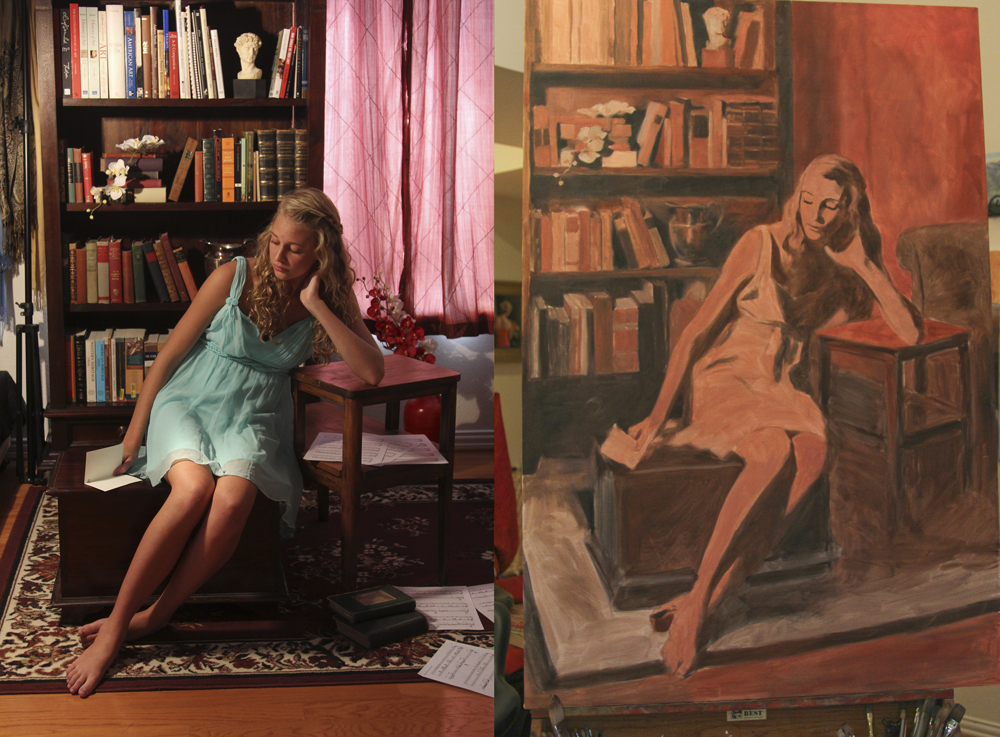
The first is a huge canvas (54" x 36") of a full-length girl, seated on a wooden chest in front of a bookshelf. The shelf is filled with old classics, art books, and various objects, including a stem of orchids, a brass pitcher, and a bust of Michelangelo's "David." The girl is holding a note and appears deep in thought. The painting is still untitled. I'm leaving her expression and pose up to interpretation, but am still working on  story line of my own. Anyway... it took me literally all afternoon to block this in. I only used white, terra rosa, and ultramarine blue for the block-in, and limited my values, especially on the figure. In the next painting session, I hope to begin developing the values more, while incorporating accurate color temperature. The light source is very warm, which is somewhat different from the usual daylight bulbs that I work with. I believe the warm lighting appropriately creates a more intimate atmosphere for this setting.

Here she is: the first image is the scene as it's set up in my studio. The second is my painting on the easel from the actual vantage point that I decided on (I'm doing this thing from life). I had to sketch the image on with charcoal before starting any of the painting. It was just too large to try eye-balling! Click the image to see larger:


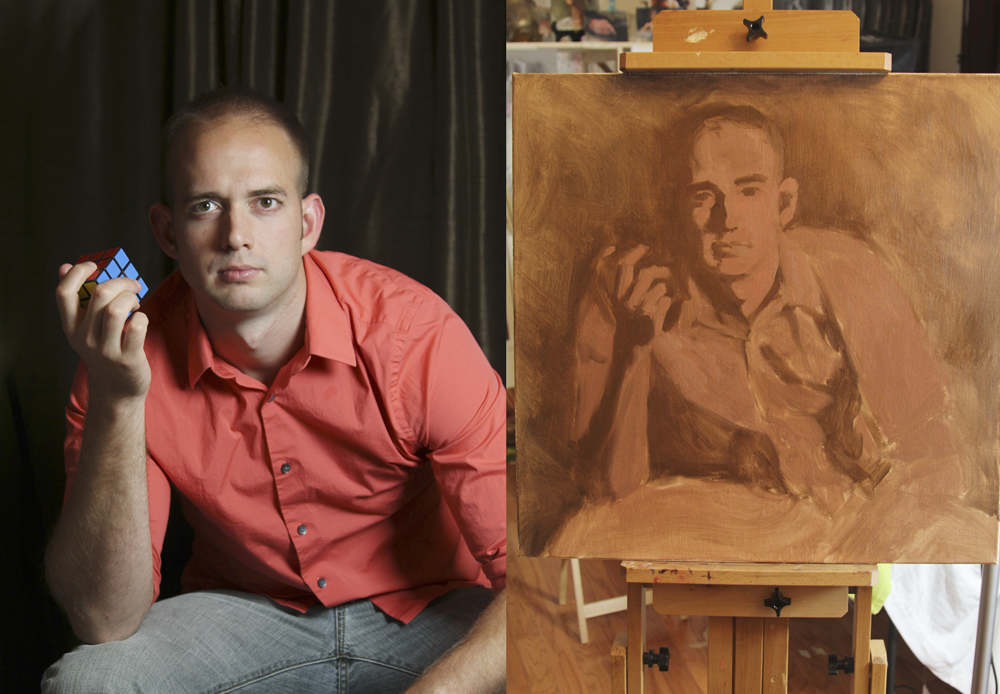
I began a second painting yesterday, some time in the evening after my husband got off of work. I have been badgering him for months now about modeling for me. We've been married for three years and he's never modeled for a portrait! Finally, last night, he was willing to sit for at least the start of one. My idea with this portrait was to bring out his wonderful quality of being a good problem-solver... and that will actually be the title of the painting: "The Problem Solver." He'll be holding a rubik's cube and looking out directly at the viewer. That's just his personality: direct, bold, strong. And since it would take me forever to solve a rubik's cube, I have to brag on my husband just a little - he can solve it in about two minutes!

Since the model lives with me (ha!), I am doing this portrait completely from life. I was only able work on it for about 40 minutes, but here is what I accomplished during that time (the dimensions are 24" x 24"):


More progress pictures to come. I'm very excited about all my projects, even if a dozen seems like an overwhelming number! I love what I do, and feel privileged every day to come into my studio and paint. I hope those of you reading this are also inspired to do what you love, and do it to the best of your ability. :-)

Tuesday, September 6

Clayton J. Beck, III Workshop at the Woodlands Art League

My head is still spinning from the overload of information I received at last week's three-day portrait and figure workshop with Clayton J. Beck, III at the Woodlands Art League. I felt extremely privileged to be there and grateful for the instruction, as it was a totally new way of thinking and painting for me.

Clayton Beck is, as my friend Michael would say, a "Schmidling," meaning that he studied under Richard Schmid once upon a time during the "golden age" of Schmid's teaching at the Palette and Chisel in Chicago. Beck now teaches there, and through his classes and workshops, he carries on the methods used by the 19th-century American artist John Singer Sargent as well as several of Sargent's contemporaries such as Anders Zorn and Joaquin Sorolla. Richard Schmid is arguably the greatest living painter, and so, to study with him or any of his former students is a HUGE privilege.


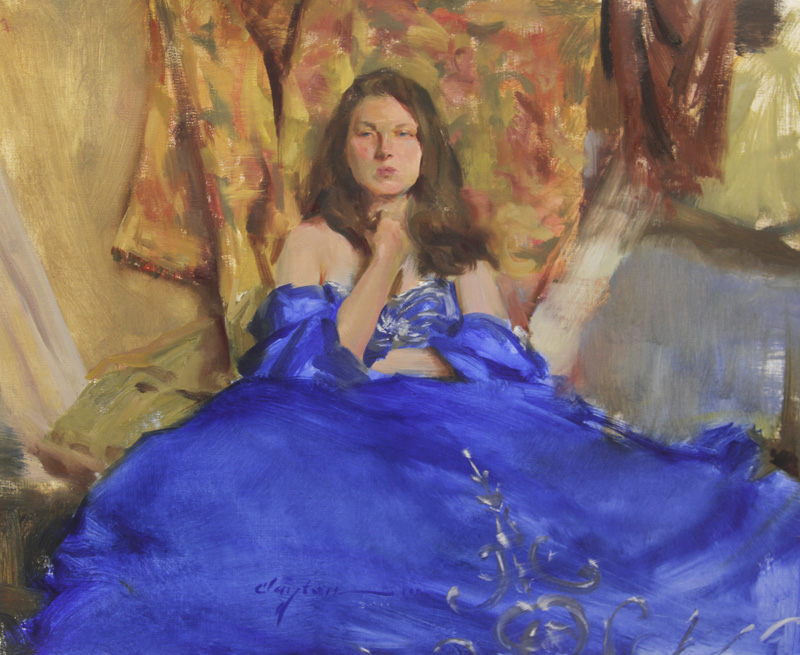
One of the many demos of Clayton's that were on display during the workshop. So inspiring!

The workshop consisted of two evening sessions with a figure model, and three full days of portrait work. Clayton's emphasis for the duration of the workshop was on values, so much so that he didn't bother to correct drawing mistakes or deal much with color (even though he's known for his ability to paint gorgeous colors!). I took a LOT of notes, but instead of writing them all down here, I'll simply share a few of the more important highlights:
  • Instead of getting wrapped up in line work to start, look at your subject in a deep squint. If you can capture the stuff you initially see in your deep squint, then you'll be all right.
  • Don't think about what things are, but rather, what they look like.
  • Never start a canvas without knowing what direction you're going in.
  • Have a realistic understanding of your own abilities and how you will react to the scene in front of you, within the time frame you are given.
  • Sometimes it's better not to have a concept. Let the model relax into the pose - yelling from eight different people to "move your arm," etc., creates tension for the model. Instead of making the model stay stiffly in the position you dictate, paint parts of the figure by opportunity. If a hand is out of place, work on something else.
  • Consistently compare areas of your painting to each other. Everything MUST relate. The harmony is in the light source, in the same way that a piece of music is written all in the same key.
  • Envision your painting from start to finish. You have control over how your painting will turn out - it is not an accident!
  • Think of everything you see as a value, an edge, or an angle, rather than a hand, hair, a mouth, etc.
  • There's no such thing as half-tone or middle value. There's only light and shadow. Look for the darkest part of the light and the lightest part of the shadow. This is where you begin your painting. Your whole world as an artist should be a division of light and shadow.
  • Work only as quickly as you can with accuracy.
  • Plan ahead; as you lay down color, know how the next brush stroke will relate to it.
  • Don't get distracted. Stick to your original idea, and finish it out.
I really enjoyed Clayton's teaching style (um... he's rather like a drill sargeant!), and I hope I get to study with him again. Here are some pictures from the last part of the workshop.

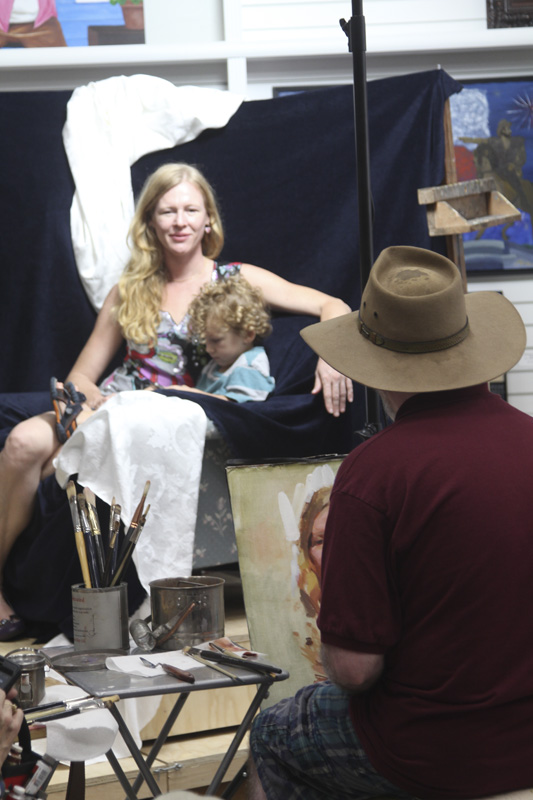
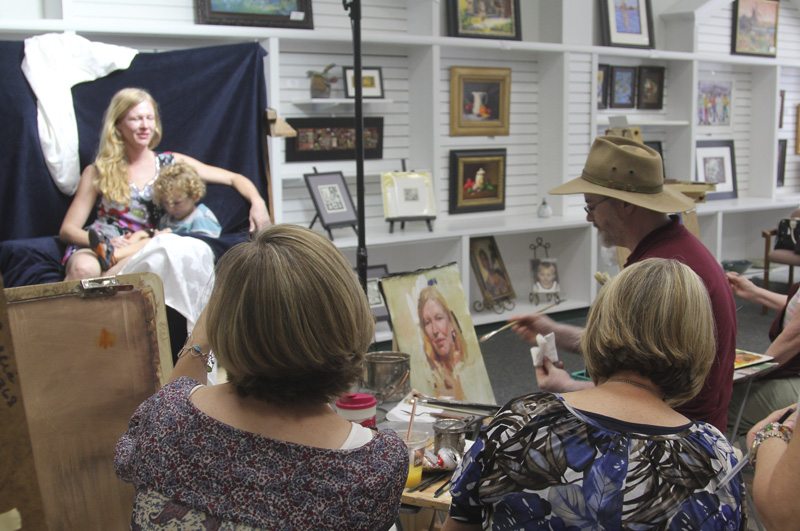
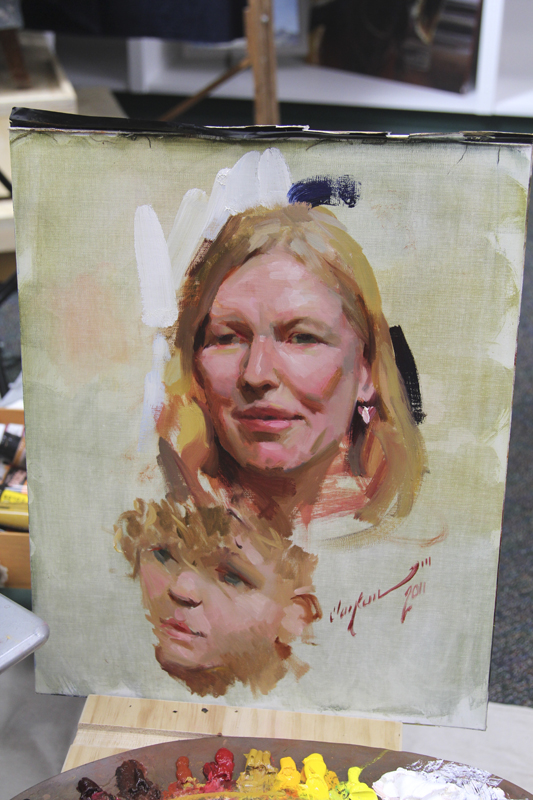
Day 3 (I was working too hard on days 1 and 2 to take many pictures, ha!): Clayton painted along side us. Here is his amazing portrait of the model so far... you can see that he established his lightest light (on our left) and darkest dark (on our right).

The model's 2-year-old son kept sitting on her lap, but he held pretty still while entertaining himself with her phone.

Clayton added an impromptu sketch of the little boy in about 20 minutes!

Here is the finished painting.

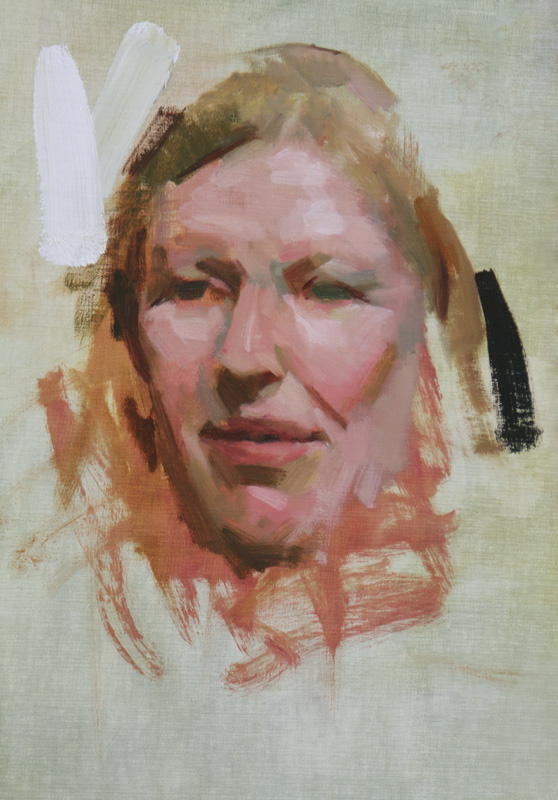
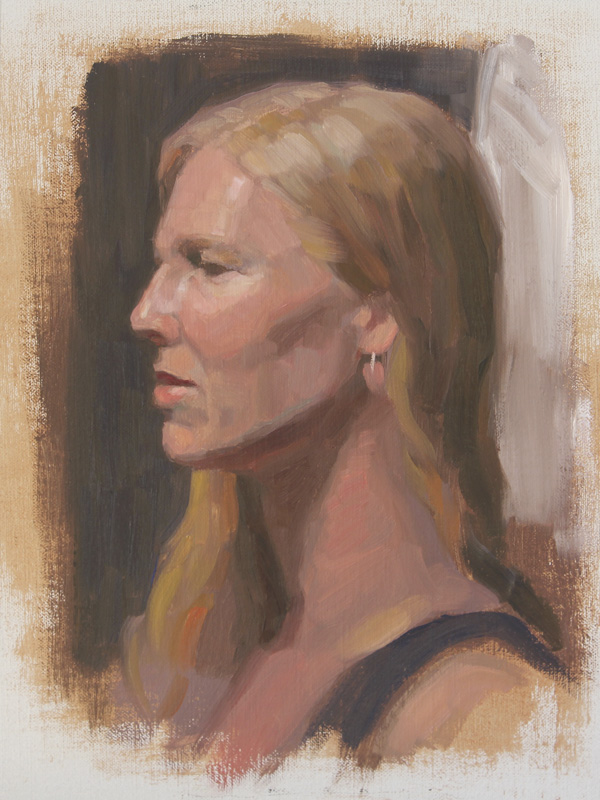
Here are my efforts from day 2 of the workshop, with our model, Pete. I was focused primarily on finding "the darkest part of the light and the lightest part of the shadow." Later I started adding in color temperature.

Day 3: My attempt at painting the model with more time spent on developing my values more gradually. The result is really a solid-looking head. I can't wait to take this method even further!

While I have a pretty solid background in classical drawing and technique (solid enough to sell my work and make a living at it, thank you very much!), I'm always excited about learning something new and adding to my painting repertoire. I've been thinking about this workshop ever since I got back from it last Friday night, and I have a feeling I'll be digesting the information for months - perhaps years! The thing that really struck me is that I had never understood how Sargent (...or Richard Schimd) painted. I always felt that their methods were completely out of reach and beyond me - that I'd never learn how to do it. I never even bothered copying a Sargent painting because I didn't know the method. Now that I've caught a glimpse of it, I'm more excited than ever to try my hand at "painting like Sargent" here at home! So now that I'm back, I've been downloading high-res images of works by Sargent, Zorn, and Sorolla from the Art Renewal Center. For those of you who are unfamiliar with the ARC, it's a fabulous resource for artists!

Well, onward... I have a lot of work to do! :-)
Related Posts Plugin for WordPress, Blogger...