Showing posts with label John Singer Sargent. Show all posts

Monday, April 30

Hunting Art Prize Gala 2012

This past Saturday, April 28, Steve and I had the privilege of attending a black tie event in Houston: the 2012 Hunting Art Prize Gala. The Hunting Art Prize, a $50,000 award given to one lucky Texas artist each year, is the most generous art prize in the United States. This year there were 1600 entries, and my painting, "Music of the Spheres" was one of 105 finalists juried into the show. The event is one night only, and consists of elaborate flower displays and ice sculptures, fancy food and expensive wine, and a select group of special guests. The best part for the finalists is that they not only have the opportunity to win 50K, but they can also sell their piece at the event. All artwork sales go directly to the artist, but are also matched by Hunting to be donated to charity. It is really an amazing event! My painting, "Twin Arts," was a finalist last year, but I was unable to attend the gala. This year I didn't want to miss it! So Steve and I found a dog sitter, drove the 4 1/2 hours to Houston, and checked into a nice hotel. We dressed to the nines and headed to the event, which was held at the Friedkin Companies Campus in Houston.

My painting had a great spot. People would come all the way across the room to look at it, because it drew them in. Ah, the power of figurative art! :-)

Here I am with my painting. We had to ship it to Houston, due to its size - I was relieved to see that it made it there in one piece! 


My painting was actually hanging next to the winner (on the right in the photo above). This year's winner was a Houston artist named Michael Bise. His winning piece was a large graphite drawing of a grade school class. There were curious-looking circles scattered throughout the drawing, which made for an interesting topic of discussion among those of us who hadn't a clue what they meant!


Sushi chefs.

Ice sculptures and desserts!


Human statues, and elaborate floral displays.


Here I am taking a closer look at the winning piece and discussing it with one of the other guests.


Steve and I both agreed that, compared to the art festivals I've been a part of in the past, this event was completely different. The guests here loved and appreciated art, and wanted to take the time to look at it and talk to the artists. By comparison, visitors to art festivals tend to breeze by or avoid eye contact with the artists, because they're afraid of getting solicited, or they are simply ignorant about art. This was not the case at the Hunting gala! Steve and I really had a great time mingling with guests, eating food, drinking wine, and enjoying the overall atmosphere, which celebrated art and culture.


And at the end of the night, I was proud to say that I SOLD my piece! There is no greater compliment to an artist or affirmation of their work than when someone is willing to purchase it! I am thrilled that "Music of the Spheres" has found a new home.

The next day, Steve and I explored Houston a little before heading back to Dallas. We visited Hermann Park (complete with an outdoor theatre, an obelisk, Japanese gardens, and a large sculpture of Sam Houston), and the Museum of Fine Arts Houston. The museum has a fantastic collection, including a beautiful portrait by Sargent.


"Mrs. Joshua Montgomery Sears," by John Singer Sargent (1899)

Overall, we had a great experience, and I look forward to entering this competition again next year!
Tuesday, September 6

Clayton J. Beck, III Workshop at the Woodlands Art League

My head is still spinning from the overload of information I received at last week's three-day portrait and figure workshop with Clayton J. Beck, III at the Woodlands Art League. I felt extremely privileged to be there and grateful for the instruction, as it was a totally new way of thinking and painting for me.

Clayton Beck is, as my friend Michael would say, a "Schmidling," meaning that he studied under Richard Schmid once upon a time during the "golden age" of Schmid's teaching at the Palette and Chisel in Chicago. Beck now teaches there, and through his classes and workshops, he carries on the methods used by the 19th-century American artist John Singer Sargent as well as several of Sargent's contemporaries such as Anders Zorn and Joaquin Sorolla. Richard Schmid is arguably the greatest living painter, and so, to study with him or any of his former students is a HUGE privilege.


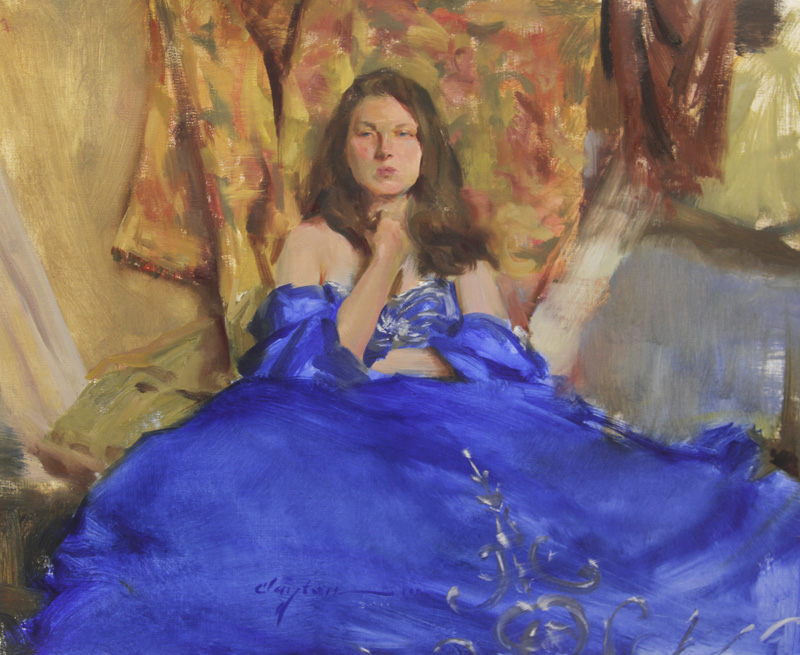
One of the many demos of Clayton's that were on display during the workshop. So inspiring!

The workshop consisted of two evening sessions with a figure model, and three full days of portrait work. Clayton's emphasis for the duration of the workshop was on values, so much so that he didn't bother to correct drawing mistakes or deal much with color (even though he's known for his ability to paint gorgeous colors!). I took a LOT of notes, but instead of writing them all down here, I'll simply share a few of the more important highlights:
  • Instead of getting wrapped up in line work to start, look at your subject in a deep squint. If you can capture the stuff you initially see in your deep squint, then you'll be all right.
  • Don't think about what things are, but rather, what they look like.
  • Never start a canvas without knowing what direction you're going in.
  • Have a realistic understanding of your own abilities and how you will react to the scene in front of you, within the time frame you are given.
  • Sometimes it's better not to have a concept. Let the model relax into the pose - yelling from eight different people to "move your arm," etc., creates tension for the model. Instead of making the model stay stiffly in the position you dictate, paint parts of the figure by opportunity. If a hand is out of place, work on something else.
  • Consistently compare areas of your painting to each other. Everything MUST relate. The harmony is in the light source, in the same way that a piece of music is written all in the same key.
  • Envision your painting from start to finish. You have control over how your painting will turn out - it is not an accident!
  • Think of everything you see as a value, an edge, or an angle, rather than a hand, hair, a mouth, etc.
  • There's no such thing as half-tone or middle value. There's only light and shadow. Look for the darkest part of the light and the lightest part of the shadow. This is where you begin your painting. Your whole world as an artist should be a division of light and shadow.
  • Work only as quickly as you can with accuracy.
  • Plan ahead; as you lay down color, know how the next brush stroke will relate to it.
  • Don't get distracted. Stick to your original idea, and finish it out.
I really enjoyed Clayton's teaching style (um... he's rather like a drill sargeant!), and I hope I get to study with him again. Here are some pictures from the last part of the workshop.

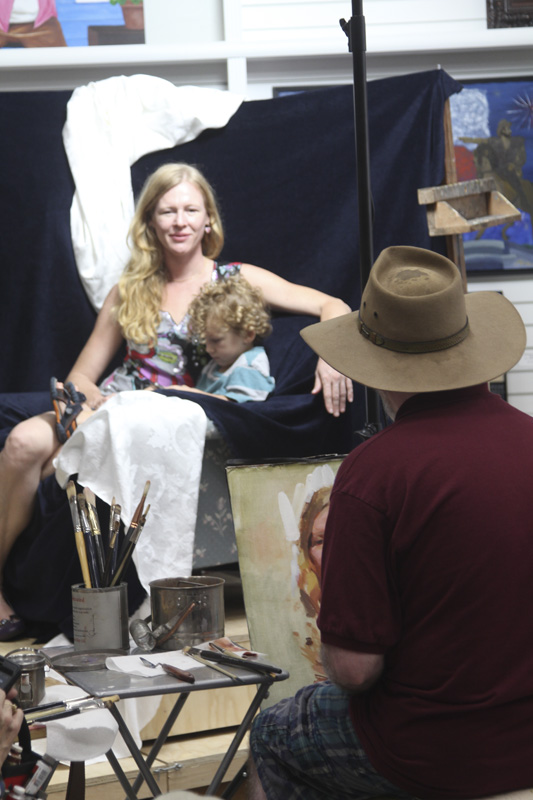
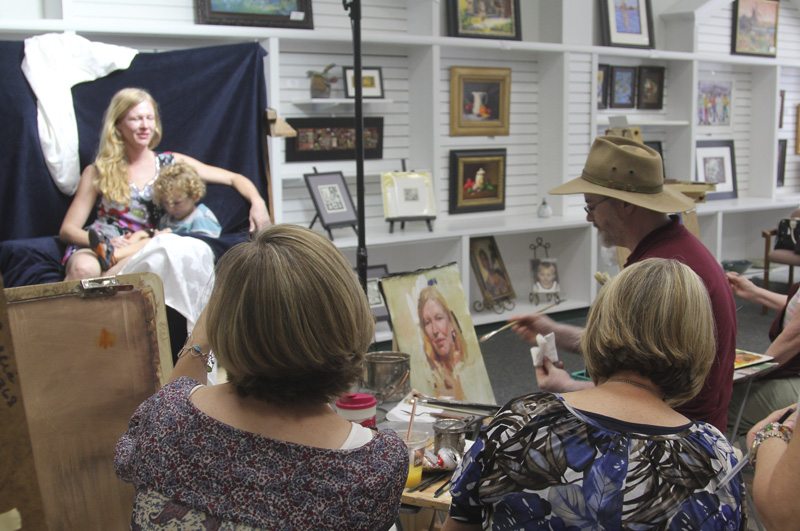
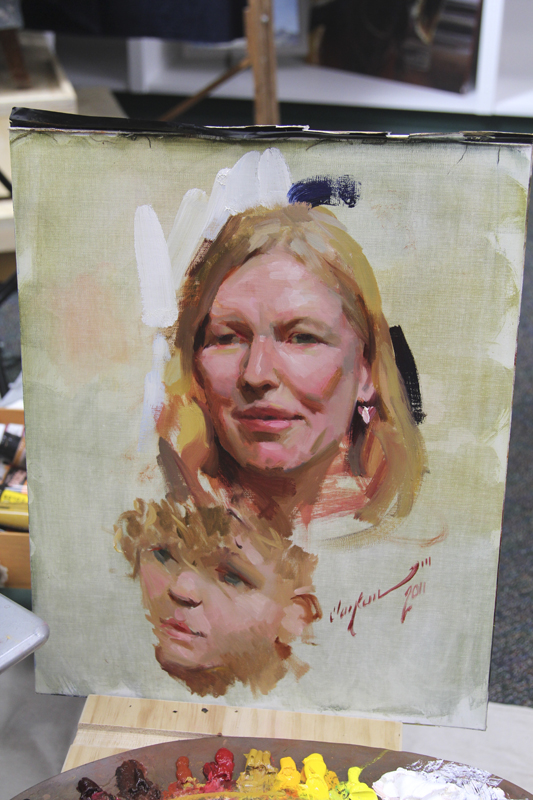
Day 3 (I was working too hard on days 1 and 2 to take many pictures, ha!): Clayton painted along side us. Here is his amazing portrait of the model so far... you can see that he established his lightest light (on our left) and darkest dark (on our right).

The model's 2-year-old son kept sitting on her lap, but he held pretty still while entertaining himself with her phone.

Clayton added an impromptu sketch of the little boy in about 20 minutes!

Here is the finished painting.

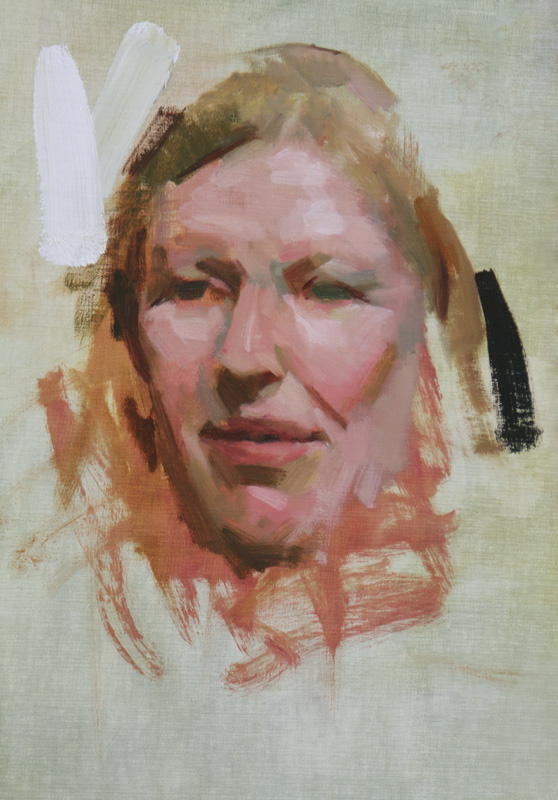
Here are my efforts from day 2 of the workshop, with our model, Pete. I was focused primarily on finding "the darkest part of the light and the lightest part of the shadow." Later I started adding in color temperature.

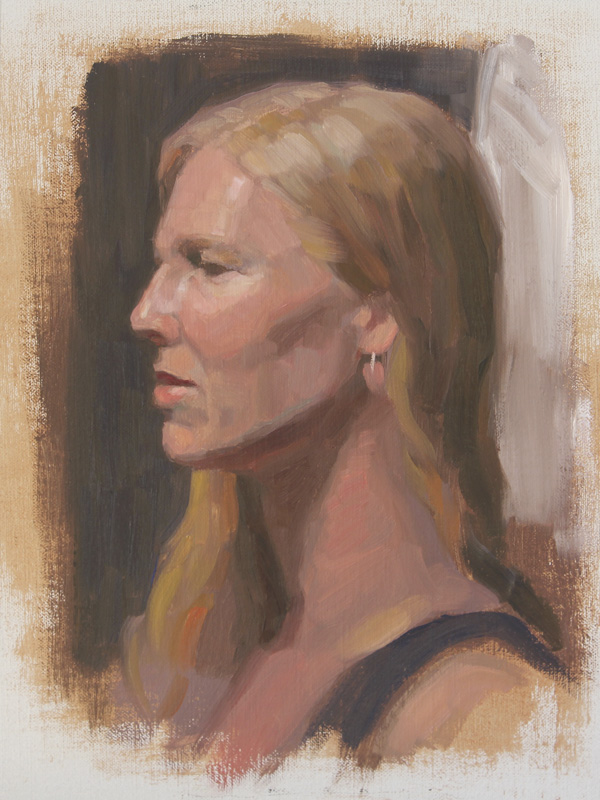
Day 3: My attempt at painting the model with more time spent on developing my values more gradually. The result is really a solid-looking head. I can't wait to take this method even further!

While I have a pretty solid background in classical drawing and technique (solid enough to sell my work and make a living at it, thank you very much!), I'm always excited about learning something new and adding to my painting repertoire. I've been thinking about this workshop ever since I got back from it last Friday night, and I have a feeling I'll be digesting the information for months - perhaps years! The thing that really struck me is that I had never understood how Sargent (...or Richard Schimd) painted. I always felt that their methods were completely out of reach and beyond me - that I'd never learn how to do it. I never even bothered copying a Sargent painting because I didn't know the method. Now that I've caught a glimpse of it, I'm more excited than ever to try my hand at "painting like Sargent" here at home! So now that I'm back, I've been downloading high-res images of works by Sargent, Zorn, and Sorolla from the Art Renewal Center. For those of you who are unfamiliar with the ARC, it's a fabulous resource for artists!

Well, onward... I have a lot of work to do! :-)
Related Posts Plugin for WordPress, Blogger...