Showing posts with label Courbet. Show all posts

Thursday, February 10

Continued - Nudity in Art from a Christian Perspective

Sorry for the wait - I wanted to have this finished two weeks ago! But when you're an artist it's a blessing to be busy, and for the past two weeks I've have been exactly that. I also hope that I'm not boring you too much with all this art history. I really believe that in viewing a work of art, it is crucial for us to understand its historical context.

So, moving on, I should at least mention briefly some of the movements that were being questioned by the 19th-century Realists and Impressionists. Up until the mid-1860s, the Paris Salon had been the main authority in art. The Salon accepted traditional work in its exhibitions, but by this time, there were already many signs that the old values were dead. Neoclassicism, Romanticism, and the work of the PreRaphaelites (please look them up - no time to expound here!) - which were characterized by a tightly academic style - tried to revive the old themes but came across as little more than pieces of sentiment and idealized genre pieces. Though much of the work from this time is breathtakingly beautiful and masterfully painted, it lacks a true connection with contemporary viewers.

Example of Academic painting that would be acceptable to the Paris Salon: Alexandre Cabanel 
"Phèdre" (1880), Musée Fabre, Montpellier

We wonder where "Christian art" was during all of this, but the spirit of the age was still very much entrenched in the ideas of the Enlightenment, and God continued to be pushed out of the picture, even in biblically themed narrative paintings. H.R. Rookmaaker describes the spirit of this age as that of the bourgeois, often characterized by the middle class. He writes (forgive the long quote, but he describes it far better than I can!):

The bourgeois were people who looked for certainty and security. With their lips they might have honoured God, but in their hearts they looked for a more 'tangible' kind of foundation. They found it in money, in a career, in status, in their moral uprightness (sound familiar??). And so morality became moralism and insurance often took the place of the assurance that God does not forsake man... These very nice people lived in the Age of Reason. And of course, they looked with dismay on the new generation who were taking to the principles of the Enlightenment. Morals were going downhill, and the old-established rules were being challenged. This was bad enough. And when the new thinkers were preaching that man was basically an animal, that his love was really only sex, then they were shocked...Yet, what could they do?  Had they not got desires themselves? Oh no, we haven't got them, they told themselves. And so they began to push the fact that man has a body, and especially his sexuality, into the dark, hidden corners of life... So towards the end of the eighteenth century the bourgeois world... began to build up the defensive attitude towards sex that later became known as Victorian. We, living so much later, and following this period, can no longer really understand what it was like in pre-Victorian times - how people knew that the fact that they had bodies and sexual urges was because they were human. We can only understand the loss of it. (Modern Art and the Death of a Culture, pp. 76-77)

Moving on to more of the secular artists leading up to Modernism... I've aleady mentioned Gustav Courbet, the leader in Realist art which bridged the gap between the traditional and the "modern" (Impressionism), and Eduard Manet, who took Courbet's ideas even further. Meanwhile, Monet, Renoir, and the other French Impressionists took their ideas about reality in a different direction - one which became gradually more accepted by the public than the work of Courbet or Manet, and is still very popular today. The general concept with Impressionism is that these artists painted what they saw, based on their visual perception of the scenes before them and how light and color could be translated to a two-dimensional image. Again, because we are so famliar with Realism and Impressionism today, it's hard for us to imagine that these art movements could be "shocking". But this kind of straight-forward reality was something the public had never seen before.

Not only was painting style and technique changing considerably, but so was subject matter. Epic historical scenes, biblical characters, gods and goddesses, and even portraits of the upper class were being replaced by matter-of-fact pictures of real people and places. There was an emptiness to it that left some artists, such as Paul Gauguin, searching for something deeper (albiet a noble cause, Christians can't accept his solution to the problem as biblical...). He wanted to depict more than the eye could see, and to avoid slavishly copying nature. His new style took on a very human approach to reality by expressing his understanding of the human situation through unique handling of paint, contour, and composition. This quest for the genuine and the real through personal expression gave the artist great freedom to use colors and design in ways that had never been tried before, and it would carry on all the way to our present day as a key characteristic of Modern art.
Guaguin was disenchanted by the lack of authenticity in urban life, and so he sought to discover a simpler, more natural lifestyle by living in the midst of a more primitive culture. His escape from civilization led him to Tahiti, where he did a series of nudes that would define his career and also make a new statement about Western attitudes towards female sexuality. Gauguin frequently used Eve, from the book of Genesis, as the object of his studies of women. He practically worshipped Manet's painting of Olympia, but according to Yale professor of humanities, Peter Brooks:

Gauguin wants something else, something that would remain fully erotic but without the connotations of shame, scandal, and exposure. That he repeatedly insisted on the figure of Eve --rather than, in the manner of Bougainville and nineteenth-century Salon painters, moving back into classical mythology and the evocation of Venus -- indicates a stubborn and no doubt accurate perception that Venus was no longer the point, no longer what nakedness was all about in the Western imagination. It is precisely Eve, with all the connotations of sin and shame, and the complex entry into the knowledge of good and evil, that is central to our perception of nudity, and that thus must be reconceived. As Gauguin stated in an interview in 1895, in response to the question why he had gone to Tahiti, 'To do something new, you have to go back to the beginning, to the childhood of humanity. My chosen Even is almost an animal; that's why she is chaste, although naked. All those Venuses exhibited at the Salon are indecent, odiously lubricious....' Thus Gauguin takes on the almost impossible challenge of revising Eve, of creating a nude in paradise whose nakedness is meant to be looked at in joy and erotic pleasure without the sense that her evident sexuality is connected to evil and pain. His success in this revision is of course dependent on a certain depersonalization of his Eve: in praising her "animality," he removes her from traditional cultural constraints and brackets her own subjectivity, in gestures that could be considered typical of both patriarchy and colonialism. (from "Gauguin's Tahitian Body," online source).
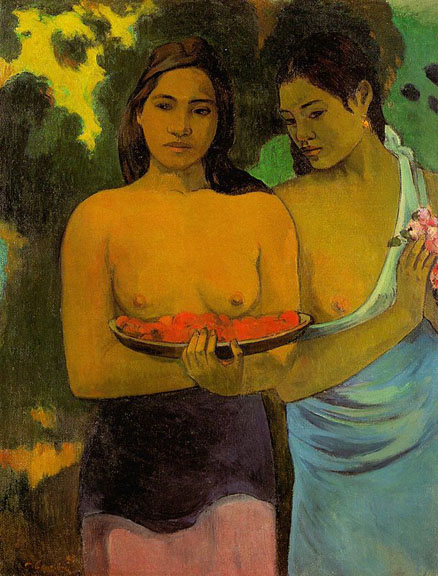
Gauguin - "Two Tahitian Women" - 1899

Gauguin's work, as Brooks goes on to describe, is very much about sexual freedom; for example, in "Two Tahitian Women," the subjects stand unabashed before us in all their erotic beauty. Their expressions are vacant, and so they become no more than an object of the male gaze.

And so, the female nude becomes objectified. But I must stop here - I will hopefully come to a conclusion in the next post. Thanks for your patience!

Monday, January 24

Nudity in Art, Part II

As I mentioned in my last post, nudity in classical art was meant to personify an idea or to reveal certain qualities of the human condition. During the Renaissance, the Catholic Church was still one of the biggest patrons of the arts, and as a result we have such priceless treasures as Giotto's The Life of Christ frescoes in Scrovegni Chapel and Masaccio's Brancacci Chapel. Both painters demonstrated new-found understanding of anatomy, foreshortening, lighting, form and drapery. Images of Christ being taken down from the cross, or being carried to his tomb, depicted Him nude or semi-nude. I find it refreshing to see the physicality of Jesus in Renaissance and Post-Renaissance painting, because the Bible tells us that He was both fully God and fully Man.

Giotto di Bondone, Lamentation, in the Scrovegni Chapel (1305) 

Of course, Michelangelo, who was greatly influenced by Humanism, took this physicality a step further in his commission for the Pope Julius II, painting the frescoes of the Sistine Chapel. The frescoes tell us the story of God's creation, man's fall, and humanity's utter need for salvation as offered by God through Jesus. With over three hundred figures, mixing both characters from biblical stories and figures from ancient mythology, Michelangelo successfully combined Christian theology with the Humanism of the Renaissance. While the amount of nudity met with some criticism, I am inclined to agree with Pope John Paul II when he said, "It seems that Michelangelo, in his own way, allowed himself to be guided by the evocative words of the Book of Genesis which, as regards the creation of the human being, male and female, reveals: 'The man and his wife were both naked, yet they felt no shame'. The Sistine Chapel is precisely – if one may say so – the sanctuary of the theology of the human body. In witnessing to the beauty of man created by God as male and female, it also expresses in a certain way, the hope of a world transfigured, the world inaugurated by the Risen Christ."

Michelangelo, detail of Adam and Eve from the Sistine Chapel (1508-1512), Rome 

The symbolism of the nude would carry on through the 18th century; we can see an excellent example of this in one of my favorite paintings from the collection of the Art Institute of Chicago, "Peace and War," by the Italian artist Pompeo Girolamo Batoni (whose work - on a side note - would later greatly influence American artists Joshua Reynolds and Benjamin West). Perhaps ahead of his time, the phrase "Make love, not war," comes to mind when looking at this painting. War is represented by the Roman god Mars, who appears fierce and unstoppable in his armor. Pax, the goddess of peace, pleads with him with her gaze and gently pushes aside his sword. Her tender breasts are exposed to symbolize both strength and vulnerability. The two simultaneously come together, and push away. It is a work of art riddled with meaning, particularly as we look at the date it was created and remember the historical events taking place at the time.

Pompeo Girolamo Batoni, Peace and War (1776), oil on canvas

However, the above painting is perhaps an exception to the trends that were already taking place by the 18th and 19th century. Art was changing considerably. Not only did God disappear from art, but so did man. Obviously enough, art is a man-made thing. It is what separates man from the animals, for we do not find animals creating works of art, erecting buildings, or composing symphonies. However, the Enlightenment stripped from man even his humanity, by turning man "natural". The consequences were severe: if man is just another animal, then the great ideas believed for centuries to be principles of truth no longer have their meaning. Can there even be such a thing as "love?" Science's answer was that love is nothing more than libido, a carnal and animalistic instinct. Love is sex. The great art critic and historian, H.R. Rookmaaker, has summed it up this way: "Life itself, instead of the varied and deep meaning it had in biblical language - man's full being, his true humanity, his work, dreams and aims, so that Christ Himself was able to say that He is the Life -- life became nothing more than biological life, the beating heart and sexual urges and quest for food and drink. We can understand the man who, standing at the end of this development, asked recently in one of the underground papers, 'Is there a life before death?'" (Modern Art and the Death of a Culture, p. 47).

That being said, nudity in art changed along with the attitudes and beliefs of the times. Around 1800, the Spanish painter Francisco Goya painted his mistress in two versions, naked and clothed. In both paintings she is laying on a couch, evocative of the goddesses from the 16th century, which would have been familiar subject matter to anyone living at the time. However, this woman is not a goddess - she is simply herself, clothed and unclothed. It is possible that Goya created these two pictures to show that Venus was dead, and all that was left was a man and his mistress.

Goya, The Clothed Maya, and the Nude Maya (c. 1800-1803), Museo del Prado, Madrid

Gustave Courbet dealt perhaps the biggest blow to traditional themes. These themes included great facts of history, biblical stories, and mythology (such as our reclining Venus), and were used to illustrate both human and Christian truths. Courbet rejected any old ideas for choice of subject matter and began to paint exclusively what he saw in the world around him. He is famous for saying, "I have never seen an angel, so I shall not paint one." Instead he painted peasants and workers, shocking the public by making these paintings as large and important-looking as any of the portraits commissioned by kings and nobles. His paintings tell us that truth lies only in what we can see and feel.  

Eduard Manet took Courbet's ideas even further, and is particularly famous for his "Luncheon on the Grass" and "Olympia." While "Luncheon on the Grass" still looks ridiculous to us, 150 years later, we can only imagine the shock with which it was received in 1863. It depicts two fully-dressed men, picnicking casually with two women who are as naked as can be. Manet painted them on a huge canvas, which would normally be reserved for grander subjects. I would love to elaborate on the history of this painting (a great source for further study is Ross King's The Judgment of Paris: The Revolutionary Decade that Gave the World Impressionism) ... but for our purposes here, the painting simply represents a rejection of the old, and an embrace of a new "reality:" that the only place we might see such a scene is in a brothel or among people of questionable propriety. Gone is the reclining Venus, or the fearless Lucricia demanding justice for the crime commited against her (another popular theme in classical art).

Eduard Manet, Luncheon on the Grass (1862-63), oil on canvas, Musée d'Orsay, Paris

Manet's "Olympia" also translated the old theme to a contemporary one, by depicting a prostitute reclining on a couch, much like a traditional Titian or Giorgione, would have shown Venus. Instead she is a high-class prostitute, waiting for a client. She gazes out at us, unabashedly and without modesty. Manet included many little details in the painting to make it clear what this woman represented; for example, the black cat symbolizes prostitution, and the orchid in her hair, cast off slipper, and pearl earrings are symbols of wealth and sensuality.

Eduard Manet, Olympia (1862-63), oil on canvas, Musée d'Orsay, Paris


In my next blog post, I will finish my brief discussion of nudity in art history, and talk about where Christianity ties in to all of this. My goal is help us become more comfortable walking into art museums, educating our children about art, and embracing art as a vocation, by understanding what we are looking at.

More to come. :-)
Related Posts Plugin for WordPress, Blogger...