Well, after coming down with a cold this week, I'm trying to muster enough energy to finish this blog series! So here we go...
We at last move to some of the modern painters and their approaches to the human form. Pablo Picasso was creative and ingenius in ways that conservatives are often resistent in giving him credit for. He was also very talented; if you look at his earlier work (before 1906), you can see that he knew classical technique and anatomy. This nude, for example, "Blue Nude", from 1902, is quite beautiful and well-rendered.
Picasso - "Blue Nude" - 1902 - private collection
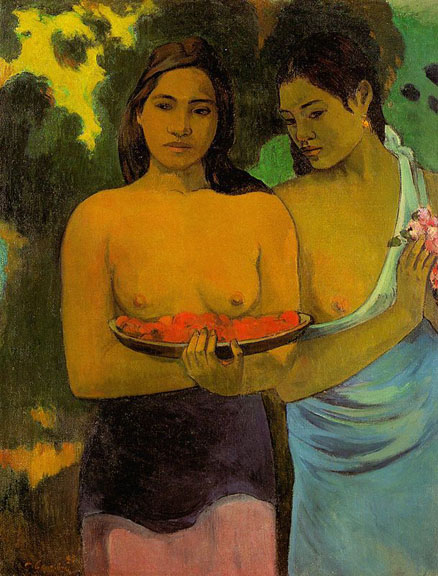
However, Picasso soon went in a different direction. While Gauguin's work had remained essentially representational, his figures were somewhat androgynous. Picasso took this much further, to a point where one could no longer distinguish between men and women, or even between a person and his surroundings. Picasso sought a solution to the universal question --"What is real?" -- in abstraction, the breaking down of forms to their most basic, simplest shapes. Cezanne had already paved the way; now Picasso made his canvas his universe, and made himself the god of it. The results are frightening. Here we see his defining Cubist work, "Les Demoiselles d'Avignon." It shows five prostitutes from a brothel in Barcelona, all painted somewhat differently. Their faces look more like demons or African masks than human. Surely this is not a depiction of the human figure as God intended it, either in form or content...

Picasso - "Les Demoiselles d'Avignon" - Oil on canvas, 8' x 7' 8" - 1907 - Museum of Modern Art, New York
Marcel Duchamp (1887-1968) broke down form even further, until nothing was recognizable and art became simply absurd. His objective was not to create art but to destroy it. Often he would give pieces a title that had nothing to do with the work, but would be suggestive in nature (for example,"The Passage of the Virgin to the Married State"), causing the viewer to look for something in it that resembled its title. One of Duchamp's most famous and controversial pieces is "Nude Descending a Staircase," an enormous abstract work consisting of cylindrical and conical elements that appear to move in space, but give us no clue as to the subject's sex, age, individuality or character.
Marcel Duchamp - "Nude Descending a Staircase" - oil on canvas - 1912 - Philadelphia Museum of Art
There is much I could say about Duchamp and his destruction of conventional art, but I must save that for another blog post. For our purposes here, it's safe to say that as Modernism progressed, the old traditions were done away with, and the beautiful nudes of classicism seemed to be gone forever.
On the bright side, there were (and are) still several outstanding artists practicing traditional techniques during the Modern era, and for their contributions, we are most grateful. These artists - Eakins, Sargent, Zorn, Sorolla, Homer, Repin and Wyath, just to name a few - kept the old aesthetic alive.
Thomas Eakins - detail from "The Swimming Hole" - 1884-45 - Amon Carter Museum, Fort Worth
I am not saying that only realistic nudes are acceptable, and that abstract art is bad! That is definitely not the point I'm trying to make. Instead, I believe that the nude is such a sensitive subject that it must be viewed from more than one angle, with questions such as, "What was the artist's intent?" "What is the historical and intellectual context?" "Was it painted to be beautiful and uplifting in some way, or to tear down and destroy?" The bigger question at hand is:
how can we as Christians accept and embrace nudity as a crucial aspect to our artistic heritage? Purpose, content, form (or execution), and context, are all crucial when observing a work of art. I agree wholeheartedly with Matt Clark, an art teacher at Veritas Academy in Lancaster, PA, who says in his article, "
A Christian Perspective on Nudity in Art", "We do a disservice to our students (and ourselves) when we teach them to be reactionary instead of thoughtful and discerning." The whole article is definitely worth reading (he includes some great Scriptural examples), especially for those of you who are teachers and are perhaps still unsure about where you stand on the issue.
In the past few blog posts, I've mentioned at least a few of the reasons for the use of nudity in art, but let me sum them up, and add a few more. Nudity can:
Symbolize great ideas or truths
Represent our humanity and help us see our need for a Savior
Depict reality, not only in secular subject matter, but in biblical subject matter as well
Help artists develop their skills in anatomy, gesture, and expression
Help us appreciate, from an aesthetic viewpoint, the beauty of the human form
This is all under a huge assumption that the nude has been depicted in the proper context and rendered with the deepest of respect. The artistic nude has been greatly abused over the past few centuries, and as a result, Christians have shied away completely. But it is time that we drop our prudishness and reclaim the nude in our art for noble purposes, like those mentioned above.
I've already discussed the first couple of points and given examples of these from art history. The third point, about art depicting reality, can be seen countless times in art history in many different forms, from the nude Christ child of Renaissance paintings to the beach scenes of Sorolla (public nude bathing was very common in 19th-century Spain), to the intimate bath scenes of women and children by Mary Cassatt. I haven't even touched on the subject of nudity in scenes depicting mothers and their children, but you probably already know my view on this - that those done by Cassatt and others (particularly women artists) are excellent works of art because they beautifully relate a level of tenderness and maternal love that is unparallelled.
Joaquin Sorolla - "Female Nude" - oil on canvas - 1902 - private collection
So let's discuss the last two points, artistic skill and aesthetics, which often go hand in hand. I’m immediately reminded of my first time drawing and painting from a nude model. I was taking a summer figure painting class at the Florence Academy of Art. There were ground rules about working with the model (i.e. no photography, absolutely no touching the model, asking the teacher to speak to the model rather than speaking to her directly, etc.). These rules seemed like common sense but only solidified the sense of awe and respect I already felt upon viewing firsthand this beautiful woman before us. To speak in Platonic terms, I was moved by the tangible presence of the model’s true “essence”. She was so... real... and as I placed her contours and shapes on my canvas, I began to comprehend that reality in my work. But with such reality came great responsibility, not just in showing respect for the model, but in how I would convey the model’s “form” to the painting's viewers. I realized it wasn't at all about me, but about a sensitivity to the subject and how that would translate to other artists and non-artists alike.
When working from the nude (at least in my own experience), there is a kind of progression that happens in the artist's mind. First, there is that awe, and an overwhelming feeling of inadequacy. There is a strange reality about the naked form that compells us to look away, and yet we can't stop looking. But once the artist begins working and observing the model, there is a breaking down of the complex for the sake of beginning - a simplification of shapes and lines and negative space. Suddenly the model is less intimidating, as I begin to see her in circles, ovals, cylinders, etc. As the drawing develops, so does my understanding of the model. Subtleties and nuances of shape and color temperature are not lost on me - those visual treasures are what I find most fascinating and fun about working from the nude. The model shifts in her pose; there are thoughts and musings going on in her head that I will never know, but perhaps I can catch a glimpse of it in my painting. It is a journey of discovery, one which, for the traditional artist, has nothing to do with sex or arousal -- only beauty. My point is, artists have studied the nude for centuries because there is no greater challenge.

Anna Rose Bain - "Florence" - Figure painting from my studies at the Florence Academy of Art, oil on linen, 2006
I like what Gordon College (a Christian school in Massechussetts) says in their policy statement on the use of nude models in art classes:
"We have chosen in the Art Department... to work respectfully with the human figure attempting to bring honor and glory to God in the process. We base this, in a Christian context, on a time-honored professional practice, holding the belief that the human form is the crowning acheivement of God in Creation - worthy of our expert knowledge, and analogous to the scientific knowledge of the human body in medicine and biology. In our tradition as artists, it is seen as the linchpin of our practice of visual knowledge. If you can accurately and expressively draw, paint or sculpt the human form, you can draw anything." 
A gorgeous example of an "academic" nude, by contemporary figurative artist Robert Liberace: "Maenid" - oil on board
In addition to developing strong technical skills by working from the nude, the artist has the wonderful opportunity to simply create a beautiful picture. This sounds a little silly, but aesthetics are no less important than any of the other points I've brought up. The visual impact of a strong composition, color harmony, and gesture can make for a great painting, without needing any kind of underlying message or narrative. One artist whose work does just that - depict beauty for beauty's sake - is California artist
Jeremy Lipking. He is one of many amazing artists who are currently helping to revive realism, and I absolutely adore his work. Here is one of my favorites, "French Beauty." This painting is not even about the porcelain nude on the couch - it is more about the stunning combination of colors and shapes, and the pleasing direction these visual elements take the eye around the painting. That red makes me exclaim, "Wow!" every time I look at it!

Here is another example by North Carolina artist
Scott Burdick -- a piece he created simply for the sake of beauty.

As I said before, there is a huge responsibility on the part of the artist as we walk a fine line by using nudity in our art. What is our purpose in painting the nude? Is it to show beauty, or incite arousal? With pornography so prevelant in our culture, and a heightened sense of eroticism in Modern art especially, it's no wonder that parents are hesitant to take their kids to art museums. I hate to subjectify the matter too much, but it really comes down to the individual. One person's art might be another's pornography. The artist may have pure motives in creating a fine art nude, simply with the intent of making a beautiful work of art and celebrating the human form... but the viewer might take it differently. Like so many other things in this world, art can start out as something good and then be perverted into something that is not. It is the artist's responsibility to keep his or her work within the proper context and to know know their own heart. The artist should also be sensitive to the viewer; if, by painting nudes, we are leading someone else astray and causing them to stumble, then to us it is sin. From a Scriptural standpoint, we can refer to Paul's epistle to the Romans:
"So then each of us shall give account of himself to God. Therefore let us not judge one another anymore, but rather resolve this, not to put a stumbling block or a cause to fall in our brother's way. I know and am convinced by the Lord Jesus that there is nothing unclean of itself; but to him who considers anything to be unclean, to him it is unclean. Yet if your brother is grieved because of your food, you are no longer walking in love. Do not destroy with your food the one for whom Christ died. Therefore do not let your good be spoken of as evil; for the kingdom of God is not eating and drinking, but righteousness and peace and joy in the Holy Spirit (Romans 14:12-17)." The artist is obviously not the only one who must be responsible in this matter. If you know your own weakness, then learn to discern what to look at and what to avoid. But don't judge others for their artistic sensibilities.
Finally, the concerned parent asks, “Why subject my child’s innocence to nudity for the sake of beauty?” The answer is:
sensitivity, education, and timing. These will be different for everyone because children mature at different rates. If nudity will cause the artist or viewer to stumble, then it should best be avoided. But I firmly believe that children should be educated about art history, so they can understand why fine art nudes are more than something to giggle at in museums! We should explain to our children that God made man and woman naked in the beginning, and that He pronounced His creation "good." But when sin entered the world and the man and woman disobeyed, they were ashamed, not of their bodies (for their bodies were God's creation), but of their sin and the realization that they were naked. Naked does not equal "bad" - instead, there is a proper time and place for it.
I thought I would close with one more example from a contemporary painter (forgive the lack of sculptural examples - I am somewhat biased, being a painter myself...). Below is a painting by Ohio artist
Carl Samson, entitled, "Triumph of Truth". It is the perfect allegory of traditional art taking back its ownership from Modernism, by depicting an athletic, spritely young woman standing defiantly atop a dead Minotaur, a subject often painted by Picasso, but in Samson's painting, rendered realistically. This painting sums up beautifully everything I have discussed from art history and in my points about the purpose of nudity in art. I would like to quote Carl Samson himself here as he explains his painting further:
"In 1907, Picasso painted 'Les Demoiselles D'Avignon' - a full frontal assault on all that was held dear by the great painters... The Demoiselles, incidentally, are featured behind this model in my painting. She's strong, confident and intent on exacting some revenge for all the injustices perpetrated on the fairer sex by Monsieur Picasso." Samson has created a masterpiece, which perhaps makes a prophetic statement about the direction of fine art. Beauty is making a comeback, with works like "Triumph of Truth" proudly paving the way.

Carl Samson - "Triumph of Truth" - 96" x 62" - oil on canvas This concludes my discussion on nudity in art from a Christian perspective. Of course, I am happy to answer any questions you have - and if you disagree with me, by all means, leave a comment! I love controversial discussions, especially over things I'm passionate about. Thanks for reading. :-)
For Further Reading and Review, here are some of my recommendations: